The finishing process for the veranda columns is detailed above. A caliper shaped jig is used to hold two straight edges in place as a formwork for the reboco/stucco brown coat.
Showing posts with label Columns. Show all posts
Monday, October 4, 2010
Friday, August 6, 2010
Week 8

Week 8 was a big week for a multitude of tasks on site. Waste water infrastructure has been installed for the two bathrooms of the school and research facilities by Ethan and Julie as seen in a following photo spread. The gray and black water have been piped separately for the opportunity to recycle the gray back into the gravity feed system that flushes toilets. The septic style pit has been built up by various workers and completed by Mindy and Max (also shown in the water photo spread).
All columns have been poured and above is a series of close up images of ten different columns. One of which the concrete was mixed on the ground. For the majority of the columns the pedreiro Joam has been mixing and the reddish tone is a product of the procedural steps in mixing in the bitonera (concrete mixer) as opposed to on the ground: Ground Mixture: sand, cement, and aggregate are mixed dry and then water is added. Bitonera Mixture: Aggregate then water then cement then sand then water = red concrete. (the aggregate being red)
Form Removal

Column form installation and removal was made exponentially easier with the arrival of Mercedes who brought with her a cordless 18v li-ion Makita Drill/Driver set (model: LXT 211A). More small things arrived on site this week, with Ethan having come back from Pocone, such as 30 meters of electrical cord, 300 screws, and drill bits.
Thursday, August 5, 2010
Form Station

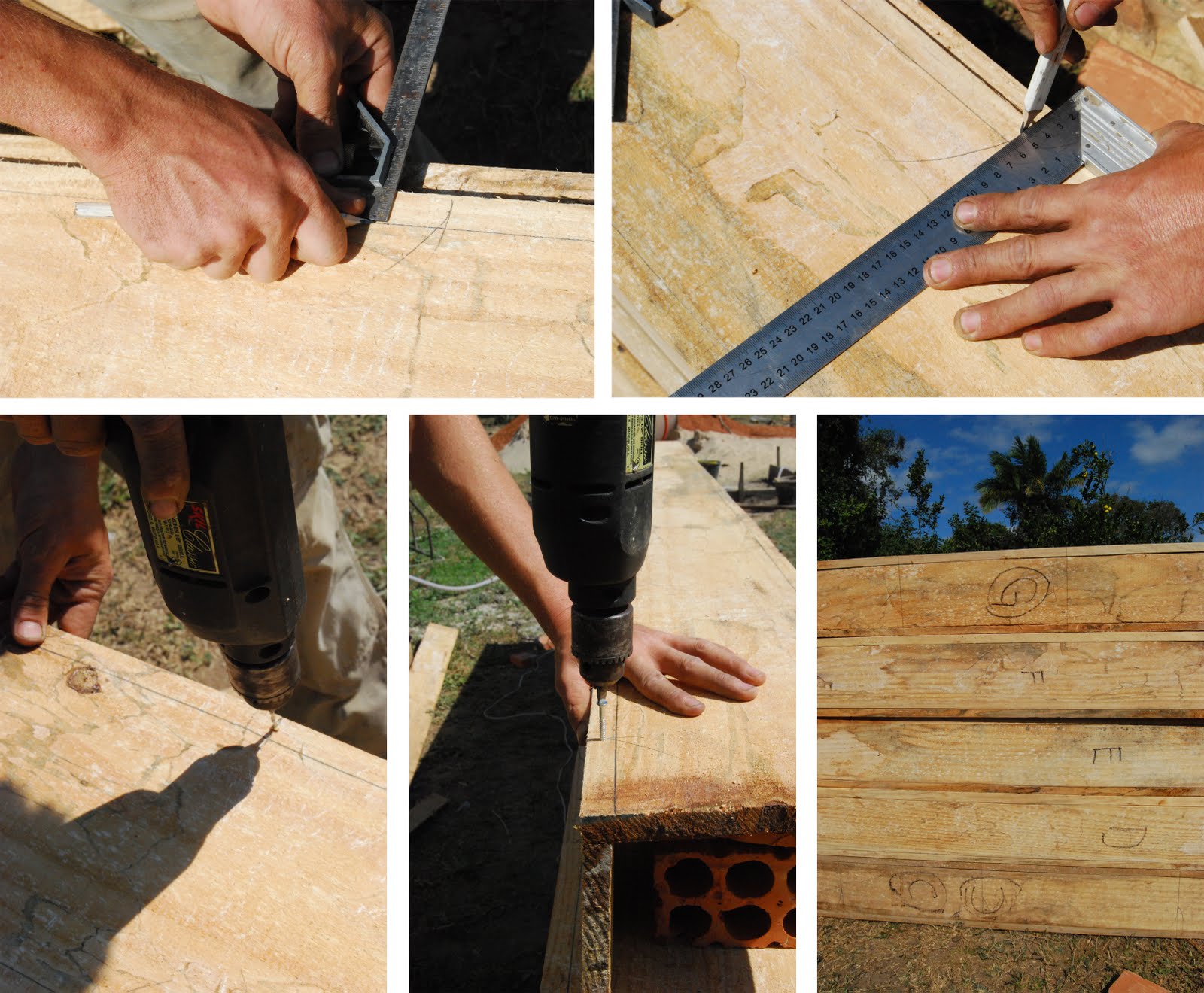
John and I set up a work station for laying out and building the form boxes needed for concrete column construction. The delivery of the electric saw and 14 pieces of form work have allowed for a more efficient production process.
Form Field

The form work construction evolved into a much more strategic and directed endeavor due to previous failures. In this image one can see the new form work. It is set around the rebar infrastructure with one face off. After the face (which is labeled with a circled letter that corresponds to the column letter) is installed, braces are applied (to get close to plumb) and heights are measured from the FFE (finish floor elevation) dry line. note: the dry line has been reestablished to account for the thickness of the form rather than the finish column. In doing so we know that all columns are level and generally plumb. When shimmed to the correct height the bottom is "pinned" with stakes and a variation of materials that land us on specific dimensions. Using a plumb bob the forms are plumbed in perpendicular directions and the braces are wired to stakes that have been set in the ground. We have also been checking diagonals in plan and elevation to make sure that all is square which has been the case being that we checked our dry lines time and again. A triple check has been measuring parallel dimensions at the base and tops of the columns. These forms have been successful and we have been getting three to four uses out of them in the overcast weather. When the wood sees much sun it warps and splits at a rapid pace. We butter them up with old cooking oil two times.
Triumph

This week (unusually cold) began with high expectations and our first real disappointment on the construction site. Although our first and second concrete column pours were a success the third and fourth would prove to reveal the instability of the initial form design. Furthermore, with the departure of architect/pedreiro’s apprentice, Nisha Patel, we have lost one of our strongest assets, both on the job and in design, which is a perpetual state in which we operate.
The initial form design deviated slightly from that which we have encountered thus far and may be one of the main reasons for its eventual failure. Due to the fact that we were ripping formwork by hand and each cut was taking between 20 and 30 min, we chose to rip only one piece, which gave us two sides of the form, and the other two sides ran long. Typical in the area is to have all pieces ripped to size with no excess, and nails attaching one piece to the next and wire (similar to bailing wire) wrapped around the form at about a 40cm interval. Well the third column became “pregnant” which is not uncommon, but the forth one blew out which we are told us also not uncommon by Joam. With one form still standing and un-poured John and I aborted the pours for the day and spent some time in the evening re-working the form design.
The new design included all pieces cut to specific lengths, screwed together for reuse, with a series of ribs spaced to resist the greatest outward force of the concrete load, and wrapped in wire. This was made easier with the arrival of an electric “Makita” or small sidewinder/circular saw Bosch GDC 14-40 with a cut depth of 40mm. The new method has worked exceptionally well and is only slowed by the fact that much of the column assembly has to be screwed together by hand. We have an electric drill but lack enough cord for it to reach the slab site, so we are assembling three sides permanently and installing and pulling the “face” of by hand. Thus far concrete and tijolo columns are going well and the system that is in place is working well.
Thursday, July 22, 2010
Week 6
Gersione returned for an extended stay meaning the large generator has finally been fixed. After blowing 3 outlets and one cord, we (really, Gersione) finally figured out a way to get the bitornera (concrete mixer) going. He also happened to bring an electric water pump with him. With these developments, concrete for the interior columns and mortar for the exterior have been at our disposal without too much extra work. On site, the columns are going up quickly as they have been the primary building focus for the three architects and Joam. This has allowed a couple of us to focus on interior columns and a couple of us on exterior columns.
Other major events:
_While James was performing the job of eco-tour driver (for the second time since we’ve been here) during a night ride, we saw a taper
_We managed to stop working for a bit and catch the second half of overtime of the final match to see Spain win the world cup for the first time ever
_The GIEU has departed and in 3 weeks time, another pedreiro (Elano, who, we mentioned before, is working on a project up the road and has provided a lot of helpful tips and tools to us) and his two men (they call men who work for pedreiros “servants” here) will arrive and focus on constructing Phase 2
Working It

We have finally been joined on site by a pedreiro (or building master) named Joam from the city. He has been working in the field of construction for 30 years but never with a woman or with Americans, both circumstances he seems to welcome. The communication was very difficult at first as he didn’t speak the clearest Portuguese (Ethan went so far as to claim that he was speaking another language, altogether) and our Portuguese is relatively slow but soon enough we were able to understand each other and communicate by showing/doing as much as possible. One of our biggest challenges is to keep up with the pedreiro’s very fast pace of working. This requires that we adapt quickly to his work methods while foreseeing the next step in the process. Once finishing all of the bond beam rebar towers and remaining column rebar towers, the next logical step for Joam was the exterior veranda columns (pier footing, rebar, retention brackets, mortar, oito furo bricks). In the meantime, we poured all footings for interior columns, constructed formwork, and began to pour the columns (composed of wood formwork greased with expired soy bean oil, vertical rebar, rebar retention brackets, rebar braces (15 X 20) to hold the formwork in place, and concrete). Another major task on site concerns the water team. They have been working away (with the helping hands of GIEU students) on the construction of the septic tank/leeching facility which is made from oito furos with the occasional brick turned sideways in order to let materials seep through. They have also been cleaning materials for their water filtration system. Both of these tasks are near completion. We also fetched the wood from deep in the forest where it had been cut and moved it to the roadside. This required a lot of bug spray and some night time adventures to move the wood from the side of the road to the building site.
Clockwise: Our “metal shop”: cutting rebar for the rebar towers, bending rebar retention brackets, assembling rebar towers; All hands on board for the pouring of the first column (we were determined to pour it that day and were trying our hardest to beat dusk); Construction of a veranda column; Placement of formwork for interior column
Subscribe to:
Posts (Atom)
.jpg)